


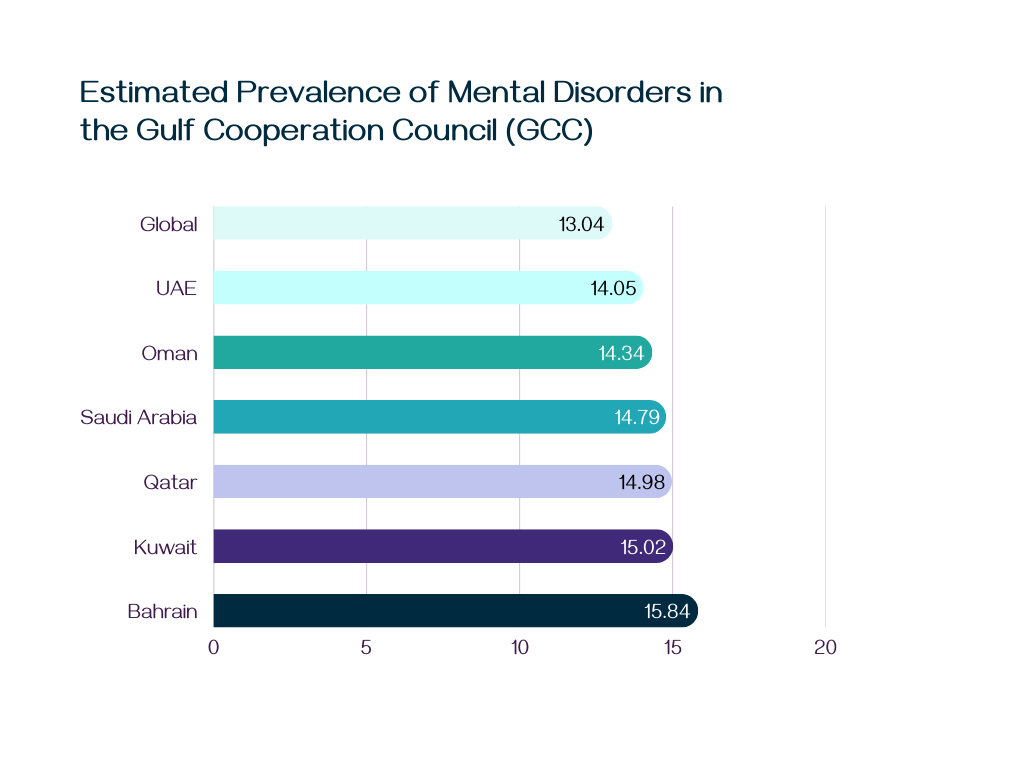
In recent years, the Gulf Cooperation Council (GCC) region has seen a rise in the prevalence of non-communicable diseases, including mental health disorders. Some reports have also indicated that the burden of such disorders is relatively higher than in some other global regions.
It is estimated that up to 15% of the GCC population experiences mental health challenges annually, with an alarming 80% of cases going undiagnosed in large markets such as Saudi Arabia.1
According to the Global Burden of Disease study, mental health conditions contribute 9% to 14% of the total disease burden in the GCC region, compared to just 7% in other high-income countries globally.1
In the GCC region, the most commonly occurring mental health conditions with notable prevalence rates include depression, anxiety disorders, eating disorders, dementia, and PTSD.
Despite the aforementioned burden, there remain some barriers to accessing effective treatment, including:
- Stigma: Misconceptions discourage seeking help.
- Workforce Gaps: Only 2.58 psychiatrists per 100,000 people, far below global averages.
- Access & Affordability: Limited insurance coverage and high out-of-pocket costs restrict care.
Notably, however, there are concerted policy and strategic initiatives designed to provide sustainable solutions to these challenges, which include, but are not limited to:
- Saudi Arabia: Launched a National Centre for Mental Health Promotion, offering helplines and community support services.2
- UAE: Incorporated mental health as a key pillar in its National Wellbeing Strategy 2031, aiming to destigmatize mental health and improve accessibility.3
- Qatar: Established an integrated mental health strategy to ensure care is accessible and stigma-free, especially for vulnerable populations. 4
At HealthNet MEA, mental health is a top priority.
We work closely with manufacturers to bring innovative therapies and support programs to the region, ensuring accessibility, awareness, and education for patients in need.
As we prepare to launch a globally recognised brand for treating a major mental health disorder in the UAE and wider GCC region, HealthNet MEA also has a configurable white label Medical Device that manufacturers, hospitals and pharmacies can leverage in supporting patient well-being/motivation/activation, including when life stressors make treatment compliance very challenging, particularly for chronic disease patients.
More specifically, this device can deploy the accredited Patient Activation Measure (PAM) to facilitate tailored support to the patient dependent on their changing activation, motivation levels and well-being; all these designed to improve patient engagement in their care.

For more information on this and collaborative opportunities, contact us at support@healthnetmea.ae







This is a really important topic! It’s encouraging to see HealthNet MEA addressing the need for better mental health support in the GCC region. Hopefully, increased awareness will lead to more accessible and culturally sensitive services for those who need them.
This was a really insightful piece! I particularly appreciated the emphasis on breaking down stigma and improving accessibility to mental health services in the GCC – these are such crucial points. The article highlights that cultural understanding and integrating mental health into primary care are key, which resonates deeply, as a one-size-fits-all approach simply doesn’t work. It’s encouraging to see these conversations happening.
This is a really insightful article highlighting the crucial need for enhanced mental health support in the GCC. I particularly appreciate the emphasis on breaking down stigma and the role of cultural factors, which are often overlooked in broader discussions. The mention of integrating mental health services into primary care, alongside tele-medicine, offers practical and promising avenues for improvement.
This is a truly insightful article on a vital topic! I especially appreciated the emphasis on breaking down the stigma surrounding mental health in the GCC, and the discussion around incorporating culturally sensitive approaches. The idea of leveraging technology for improved access and support, as mentioned, feels particularly promising for the region.
This is an important conversation for the GCC, where greater awareness can help make mental health support more accessible and accepted. I appreciate the focus on encouraging open dialogue and reducing stigma around seeking help.